
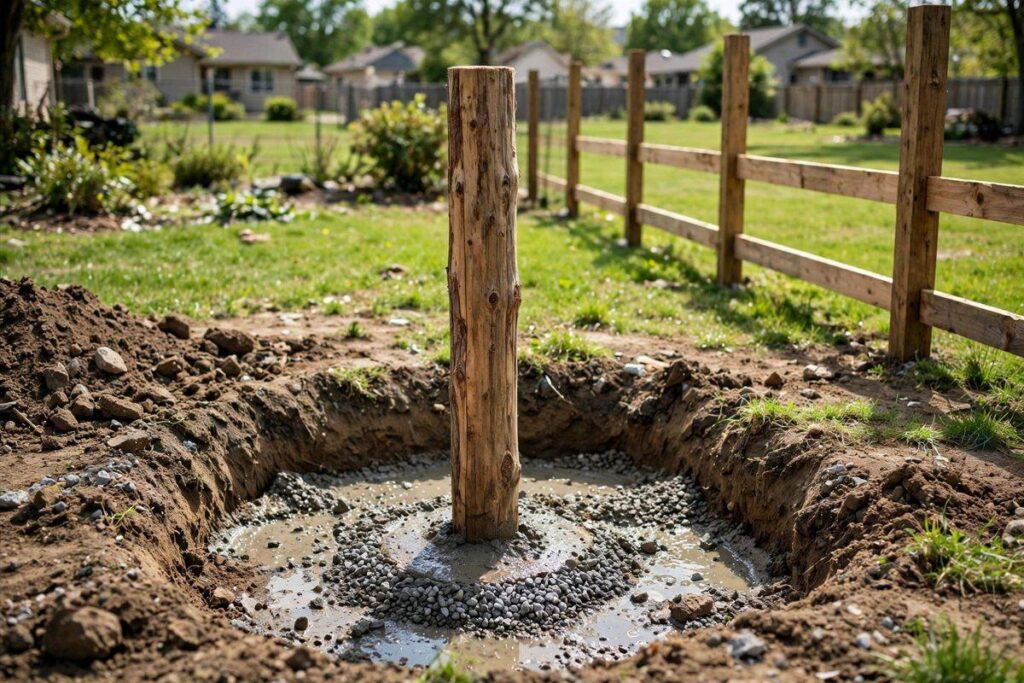
How deep should fence posts be? For most fences, the hole should be one-third of the post’s above-ground height — and never less than 24 inches deep. A 6-foot fence needs a 24-inch hole, and in cold climates the hole must also go below the frost line, even if that means digging deeper. Use our fence post depth calculator to get the exact depth, hole size and concrete bags for your fence before you dig.
The Short Answer: The 1/3 Rule
The rule every fence builder uses is simple: bury one-third of the post. A post that stands 6 feet above the ground needs 2 feet in the ground. That ratio keeps the fence standing through wind, rain and frost heave.
Two minimums override the rule:
- Never less than 24 inches deep, even for a short 4-foot fence. The 1/3 rule would give 16 inches for a 4-foot fence — too shallow to hold.
- Always below the frost line. When the ground freezes, it expands and pushes shallow posts upward (frost heave). Your hole must reach below the deepest frost in your area.
On top of the hole depth, add 6 inches of gravel at the bottom for drainage. So a 24-inch hole means digging 30 inches down in total.
How Deep Should Fence Posts Be for a 6-Foot Fence?
A 6-foot fence is the most common backyard fence, and the answer is straightforward: 24 inches deep, plus 6 inches of gravel underneath — 30 inches of digging in total. If your local frost line is deeper than 24 inches, dig below the frost line instead. In warm southern states the frost line may be only a few inches deep, so the 24-inch minimum governs. In cold northern states the frost line can sit 36–48 inches deep (deeper still in the far north) — your local building department publishes the exact number, and it is the number that matters.
| Fence height above ground | Hole depth (1/3 rule) | Dig total (with 6″ gravel) |
|---|---|---|
| 4 ft | 16 in — use the 24 in minimum | 30 in |
| 6 ft | 24 in | 30 in |
| 8 ft | 32 in | 38 in |
If the frost line in your area is deeper than the number in this table, the frost line wins. A fence that ignores the frost line will lean within a winter or two.
How Wide Should the Hole Be?
Depth is only half the job. The hole should be about three times as wide as the post. A standard 4×4 post (3.5 inches wide) needs a hole about 10–12 inches across. That width gives the concrete enough grip to hold the post against wind. That width matters as much as how deep should fence posts be — a shallow hole with wide concrete still leans.
A narrow hole saves digging but costs you the fence: the post has nothing to hold on to, and the first strong storm will lean it.
How Much Concrete Per Hole?
For a standard 10-inch hole at 24 inches deep, plan on about two 80-lb bags of concrete per hole. The exact count depends on the hole diameter and depth, so run your numbers through our fence estimator — it works out posts, sections, rails and concrete bags for the whole fence at once.
Set the post on the 6-inch gravel base, brace it plumb, pour the concrete, and slope the top of the concrete away from the post so rainwater runs off instead of pooling against the wood. Let the concrete cure 24–48 hours before hanging panels or rails.
Common Mistakes
- Digging too shallow. The most common reason fences lean. When in doubt, go deeper — an extra 6 inches costs minutes and saves the fence. Remember, how deep should fence posts be is the first question to settle before you buy a single bag of concrete.
- Skipping the gravel base. Without drainage, water sits at the bottom of the hole and rots the post from below.
- Ignoring the frost line. A fence built to the 1/3 rule but above the frost line will heave in the first freeze.
- Setting posts out of plumb. Check with a level on two sides before the concrete sets — a leaning post cannot be fixed later.
- Mounding concrete above ground level. A mound traps water against the post. Slope it away instead.
Bottom Line
How deep should fence posts be? One-third of the above-ground height, never less than 24 inches, always below the frost line, on 6 inches of gravel. For a 6-foot fence that means a 24-inch hole and 30 inches of digging. Get your exact numbers — depth, hole size and concrete bags — from our fence post depth calculator before you pick up the digger.
Written by the Yard & Bag Editorial Team. Our content is researched and checked against supplier guidance and standard building practice.