
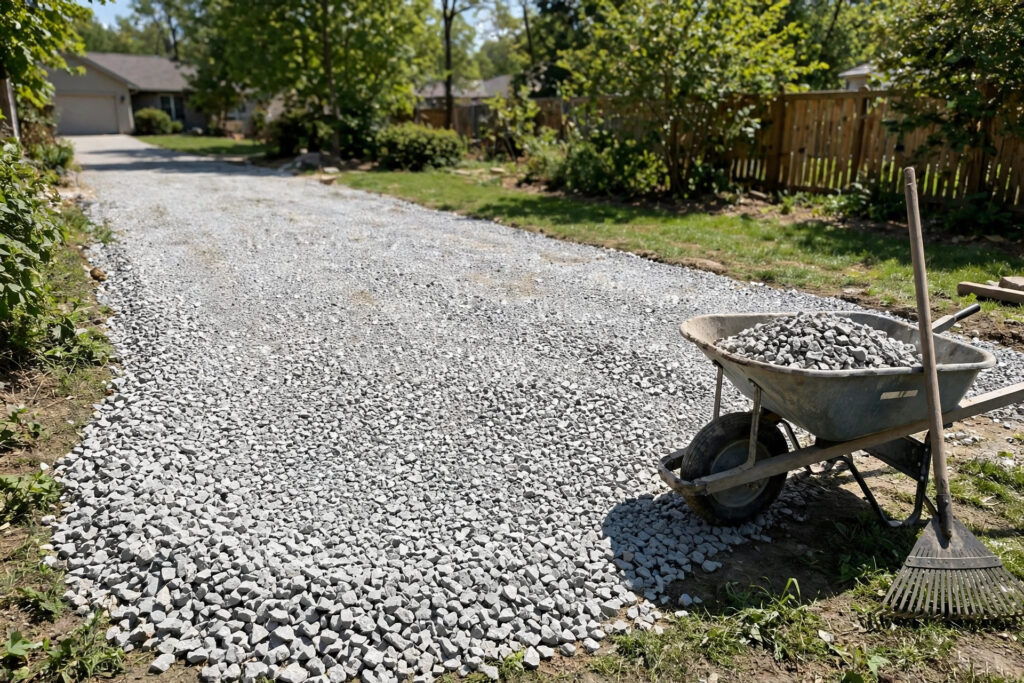
How much stone do I need? It depends on the area and the depth. A driveway base needs 4 to 6 inches, a walkway needs 2 to 3 inches, and a drainage bed needs 4 to 6 inches. Measure the length and width, pick your depth, and our free Stone Calculator turns it into cubic yards, tons and bags.
How Much Stone Do I Need? (By Project)
Different jobs need different depths of stone:
- Driveway base: 4 to 6 inches of crushed stone, compacted in layers
- Walkway or patio base: 2 to 4 inches
- Drainage bed or French drain: 4 to 6 inches around the pipe
- Garden path: 2 to 3 inches
- Decorative stone bed: 2 to 3 inches
- Under a shed or patio slab: 4 inches
Stone settles and compacts, especially crushed stone, so add 10 percent extra to your order. A short load costs more than a little extra stone, because a second delivery often costs as much as the first.
How Much Stone Do I Need per Square Foot?
One cubic yard of stone covers about 100 square feet at 3 inches deep. The coverage changes with the depth:
- 2 inches deep: about 150 square feet per cubic yard
- 3 inches deep: about 100 square feet per cubic yard
- 4 inches deep: about 75 square feet per cubic yard
- 6 inches deep: about 50 square feet per cubic yard
For example, a 10 by 20 foot driveway at 4 inches deep needs about 2.5 cubic yards. A 3 by 30 foot walkway at 3 inches deep needs about 1 cubic yard. Our Stone Calculator does this math for any size, including round and triangular areas. The Natural Stone Institute publishes guidance on choosing natural stone for driveways, patios and landscaping. How much stone do I need for a drainage bed? About 1 cubic yard per 50 square feet at 6 inches deep.
How Much Does a Cubic Yard of Stone Weigh?
One cubic yard of crushed stone weighs about 2,700 pounds, or about 1.35 tons. The exact weight changes with the stone type:
- 3/4-inch crushed stone: about 2,700 pounds per cubic yard (about 1.35 tons)
- Crusher run: about 2,800 pounds per cubic yard (about 1.4 tons)
- Pea gravel: about 2,600 pounds per cubic yard (about 1.3 tons)
- River rock: about 2,700 to 2,900 pounds per cubic yard, depending on the size
- Recycled concrete: about 2,500 pounds per cubic yard (about 1.25 tons)
Wet stone can weigh 5 to 10 percent more than dry stone. To turn cubic yards into tons, multiply the cubic yards by 1.35 for crushed stone. Our Stone Calculator shows cubic yards, tons and bags together.
Which Stone Should I Use?
The right stone depends on the job. Crushed stone locks together when compacted, so it is the best choice for driveways, walkways and patio bases. Round stone like pea gravel and river rock does not lock together, so it shifts underfoot — it is better for decoration and drainage, not for driving on.
- Driveway or walkway base: 3/4-inch crushed stone or crusher run
- Drainage: clean 3/4-inch stone or river rock, which lets water through
- Garden paths: pea gravel or small river rock
- Decorative beds: river rock or pea gravel
- Under pavers or slabs: crushed stone, compacted in layers
For gravel-specific projects, such as a gravel driveway, see our Gravel Calculator. For any other stone job, the stone calculator works out the amount for the depth and area you measured.
How Many Bags of Stone Do I Need?
Bagged stone is usually sold in 50-pound bags, and each bag holds about 0.5 cubic feet. One cubic yard equals 27 cubic feet, so it takes about 54 bags to make one cubic yard.
- 1 cubic yard = about 54 bags of 50 pounds
- 2 cubic yards = about 108 bags
- 5 cubic yards = about 270 bags
Bags make sense for a small path or a top-up. For a driveway or a large area, bulk delivery is far cheaper per cubic yard. Put the same measurements into the stone calculator to see the bag count next to the bulk cubic yards.
Common Mistakes to Avoid
- Using round stone for a driveway. It shifts under tires and never packs down — use crushed stone instead.
- Skipping the base. Stone laid straight on soft ground sinks and disappears within a season.
- Under-ordering. Stone compacts by about 10 percent, so add 10 percent extra.
- Forgetting the edging. Without edging, stone spreads into the lawn and the bed gets thinner every month.
- Comparing prices in different units. Convert tons and cubic yards to the same unit before comparing suppliers.
Bottom Line
Measure the area, pick the depth, and add 10 percent for compaction. A 10 by 20 foot driveway at 4 inches deep needs about 2.5 cubic yards. Use our free Stone Calculator to work out the cubic yards, tons and bags for your project before you order. So how much stone do I need? For most jobs, measure the area, pick the depth, and add 10 percent.
Written by the Yard & Bag Editorial Team. Our content is researched and checked against supplier guidance and standard building practice.