
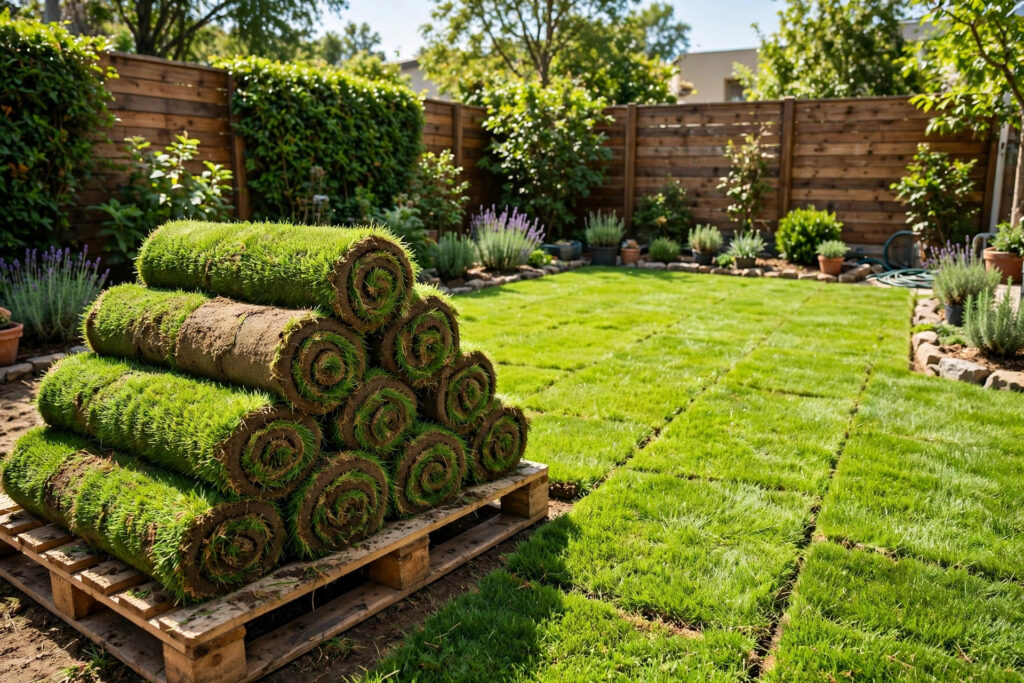
How much sod do I need? Measure your lawn in square feet, add 5 to 10 percent for waste, then divide by the coverage of a roll (10 sq ft) or a pallet (about 450 sq ft). A 1,000 sq ft lawn needs about 1,100 sq ft of sod with waste — 110 rolls, or 3 pallets. Our free sod calculator does the same math for your exact lawn shape.
The Short Answer
| What you measure | How much sod to order |
|---|---|
| Lawn area | Length × width, in feet, = square feet |
| Waste allowance | +5% for simple rectangles, +10% for curves and irregular edges |
| Rolls | Total sq ft ÷ 10 (a standard roll covers 10 sq ft) |
| Pallets | Total sq ft ÷ 450 (a standard pallet covers about 450 sq ft) |
Mississippi State University Extension recommends buying about 5 percent more sod than you think you’ll need — enough to cover cuts around beds, paths and curved edges without leaving you short.
How Much Sod Do I Need per Roll and Pallet?
Sod is sold by the roll (or piece) and by the pallet:
| Unit | Typical size | Coverage | Weight |
|---|---|---|---|
| Standard roll | 2 ft × 5 ft | 10 sq ft | about 25–35 lbs |
| Slab / piece | 16 in × 24 in | about 2.7 sq ft | about 5 lbs each |
| Pallet | about 45–50 rolls | about 450–500 sq ft | about 1,500–2,500 lbs |
Coverage varies by farm and grass type, so always confirm the roll and pallet coverage on your quote before ordering. A pallet typically contains 450 to 500 square feet, and most farms plan on 450.
How to Calculate Sod, Step by Step
- Measure the lawn. For a rectangle, multiply length by width. A 40 × 30 ft lawn is 1,200 sq ft.
- Break up irregular lawns. Split L-shapes, curves and strips into rectangles, triangles and circles, work out each piece, and add them up.
- Add waste. 5% for a plain rectangle, 10% for curves, slopes and lots of edges. A 1,200 sq ft rectangle at 10% becomes 1,320 sq ft.
- Divide into rolls and pallets. 1,320 sq ft ÷ 10 = 132 rolls; 1,320 ÷ 450 = 2.9, so 3 pallets.
Sod Quantity Chart
Worked out at 450 sq ft per pallet, with 5% and 10% waste:
| Lawn area | Order (+5%) | Rolls | Pallets | Order (+10%) | Rolls | Pallets |
|---|---|---|---|---|---|---|
| 200 sq ft | 210 sq ft | 21 | 1 | 220 sq ft | 22 | 1 |
| 500 sq ft | 525 sq ft | 53 | 2 | 550 sq ft | 55 | 2 |
| 1,000 sq ft | 1,050 sq ft | 105 | 3 | 1,100 sq ft | 110 | 3 |
| 1,500 sq ft | 1,575 sq ft | 158 | 4 | 1,650 sq ft | 165 | 4 |
| 2,000 sq ft | 2,100 sq ft | 210 | 5 | 2,200 sq ft | 220 | 5 |
| 5,000 sq ft | 5,250 sq ft | 525 | 12 | 5,500 sq ft | 550 | 13 |
Once you know how much sod do I need, run your exact measurements through our sod calculator before you order — it works out the rolls, pallets and cost in one go.
The Whole-Pallet Trap
Pallets round up, and that rounding is usually a bigger effect than the waste percentage. A 1,000 sq ft lawn with 5% waste needs 1,050 sq ft — but you cannot buy 2.3 pallets. You buy 3, and three pallets deliver about 1,350 sq ft: 350 sq ft more than the lawn. That is the real overbuy, and it spikes just past each pallet boundary.
Two ways to soften it: ask the farm whether it sells loose pieces on top of full pallets (many do — you can order 2 pallets plus 75 slabs instead of a third full pallet), and plan to use the spare sod on worn patches, bare strips along the driveway, or the side yard. Sod dries out fast once cut, so lay it the day it arrives.
How Much Topsoil Under Sod?
Good soil prep helps sod root fast. Many installers spread 2 to 4 inches of topsoil before laying. The volume is simple: cubic yards = square feet × depth in inches ÷ 324. A 1,000 sq ft lawn at 3 inches needs about 9.3 cubic yards. Work it out exactly with our topsoil calculator.
How Much Does Sod Cost?
Sod costs about $0.30 to $0.90 per square foot, depending on grass type and region. Bermuda is the cheapest (about $0.30–$0.40), Kentucky bluegrass sits in the middle (about $0.35–$0.55), and Zoysia is the most expensive (about $0.60–$0.90). A pallet typically costs $150 to $450. For a 1,000 sq ft lawn, expect roughly $300 to $900 for the sod itself — delivery and installation are extra.
Bottom Line
So how much sod do I need? Measure the lawn, add 5% for a simple rectangle or 10% for curves and edges, then divide by 10 for rolls or 450 for pallets — and remember pallets round up, so check whether your farm sells loose pieces before you order a whole extra pallet. Use our free sod calculator to work out your exact order before you call the farm.
Frequently Asked Questions
How much sod do I need for 1,000 square feet?
About 1,050 to 1,100 square feet with waste — 105 to 110 rolls of 10 sq ft, or 3 pallets at 450 sq ft each. Three pallets deliver about 1,350 sq ft, so ask the farm about loose pieces if you want to avoid the extra.
How many rolls of sod are in a pallet?
About 45 to 50 rolls of 10 sq ft each, or about 169 slabs of 16 × 24 inches. A standard pallet covers about 450 to 500 square feet and weighs roughly 1,500 to 2,500 lbs, more when wet.
How much does a pallet of sod cover?
A standard pallet covers approximately 450 to 500 square feet. Mississippi State Extension gives 450 to 500; some farms go up to 700. Always confirm the coverage with your supplier, since that number decides how many pallets you order.
How much sod do I need for 500 square feet?
About 525 to 550 square feet with waste — 53 to 55 rolls, or 2 pallets. Two pallets deliver about 900 sq ft, so loose pieces are worth asking about for a lawn this size.
Can I order sod by the roll instead of a pallet?
Many farms sell loose rolls or slabs on top of full pallets — ask before ordering a whole extra pallet. Sod is cut fresh to order, so order short and you wait days for more; order too much and the extra rolls dry out.
Written by the Yard & Bag Editorial Team. Our content is researched and checked against supplier guidance and standard building practice.