
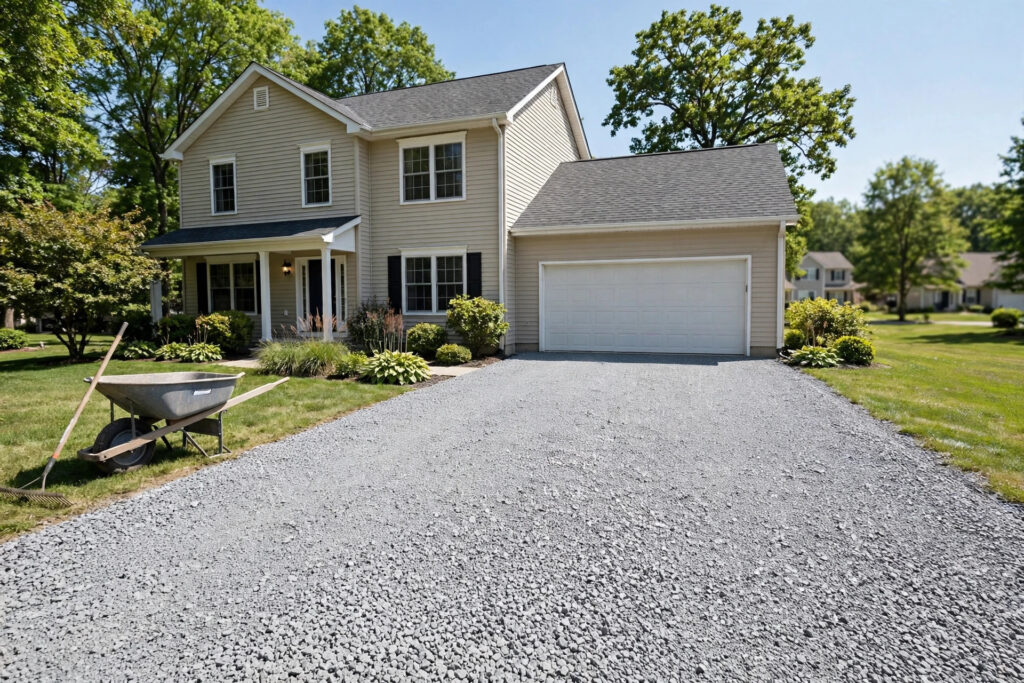
How much gravel do I need for a driveway? The short answer: measure your driveway in feet, multiply length by width by depth, and divide by 27. That gives you cubic yards. For a standard 4-inch-deep driveway, a 10-by-20-foot driveway needs about 2.5 cubic yards, and a 12-by-50-foot driveway needs about 7.5 cubic yards. Add 5 to 10 percent extra for settling and waste. Use our gravel driveway calculator to work out the exact amount for your driveway before you order.
If you want the exact number for your driveway, use our free Gravel Calculator. It works out cubic yards, tons and bags in seconds. The rest of this guide explains the depth, the gravel type and the cost, so you can order with confidence.
How Much Gravel Do I Need for a Driveway? (Sizes Table)
The formula is simple: length (feet) x width (feet) x depth (inches) / 324 = cubic yards. Or, if you prefer, length x width x depth (in feet) / 27 = cubic yards.
Here is a quick table for a 4-inch-deep driveway, the most common depth:
- 10 x 20 feet (single car, short): about 2.5 cubic yards, about 3.5 tons
- 12 x 25 feet (single car, long): about 3.7 cubic yards, about 5 tons
- 12 x 50 feet (two cars): about 7.4 cubic yards, about 10 tons
- 20 x 50 feet (wide, two cars): about 12.3 cubic yards, about 16.5 tons
- 24 x 60 feet (large, rural): about 17.8 cubic yards, about 24 tons
One cubic yard of gravel weighs about 2,700 pounds, or about 1.35 tons. That weight matters for delivery, because a standard dump truck carries about 10 to 14 cubic yards, and the delivery spot needs to take the weight. Our gravel driveway calculator does that weight conversion for you — enter the dimensions and it shows cubic yards, tons and bags together. The table above answers how much gravel do I need for a driveway in both cubic yards and tons.
How Deep Should Driveway Gravel Be?
Four inches is the standard depth for a gravel driveway that carries cars. That is 4 inches of gravel on top of a 4-inch compacted base of larger crushed stone. The base is what keeps the driveway from rutting and sinking.
- Light use (foot traffic, occasional car): 3 to 4 inches of gravel is enough.
- Daily cars: 4 inches of gravel over a 4-inch base.
- Heavy trucks or RVs: 6 inches of gravel over a 6-inch base.
Going thinner than 3 inches saves money up front, but the gravel spreads, ruts form, and you will be topping it up every year. Going thicker than 6 inches wastes material. Four inches over a proper base is the sweet spot for most homes. Our gravel driveway calculator uses 4 inches as the default depth for a standard car driveway. How much gravel do I need for a driveway at 6 inches deep? Multiply the 4-inch figure by 1.5.
What Type of Gravel Is Best for a Driveway?
Not all gravel works for a driveway. Round stones like pea gravel and river rock look good, but they shift under tires and rut quickly. For a driveway, you need angular crushed stone that locks together when compacted.
- 3/4-inch crushed stone: The most common driveway gravel. Angular pieces lock together, drain well and compact into a firm surface.
- Crusher run: A mix of crushed stone and stone dust that packs down almost like concrete. Very firm, and a good choice for the top layer.
- #57 stone: Clean crushed stone, about 1 inch in size. Drains well and is often used as the base layer under a finer top layer.
- Recycled concrete: Crushed old concrete. Cheaper than new stone and packs well, but the color and quality vary.
A good driveway build is two layers: a base of larger stone (#57 or crusher run), compacted, then a top layer of 3/4-inch crushed stone, compacted again. If you are topping up an existing driveway that already has a solid base, a single layer of 3/4-inch crushed stone is usually enough. The National Stone, Sand & Gravel Association represents the producers who quarry and grade the crushed stone used for driveways and roads.
How Much Does a Gravel Driveway Cost?
Gravel itself usually runs about $30 to $60 per cubic yard delivered, with prices varying by region and stone type. Delivery is often $50 to $150, and some suppliers charge less for a full truckload.
For a typical two-car driveway (12 by 50 feet, 4 inches deep), the gravel costs roughly $250 to $500 delivered. If you are building a new driveway from scratch, add the base stone, landscape fabric, edging and labor. A professionally installed gravel driveway usually runs $1,500 to $4,000 in total, depending on size and site conditions. DIY saves the labor cost, which is often half the total. Put your driveway’s measurements into our gravel driveway calculator to see the cubic yards and tons behind that price before you get quotes. So how much gravel do I need for a driveway this size? The table above gives 7.4 cubic yards for a 12-by-50-foot driveway, before the extra 5 to 10 percent.
How to Order Gravel for a Driveway
- Measure the length and width in feet, and decide the depth (4 inches for most driveways).
- Work out the cubic yards with our Gravel Calculator, and add 5 to 10 percent for waste.
- Get two or three quotes from local suppliers, and ask whether delivery is included.
- Pick a delivery spot the truck can reach, as close to the driveway as possible.
- Spread the gravel in layers, compacting each layer with a plate compactor or by driving over it.
If you are building a new driveway, lay landscape fabric over the soil before the base stone. It stops weeds and keeps the stone from sinking into the soil. For the base layer, see our Stone Calculator to work out how much base stone you need. Our gravel driveway calculator works out the top layer; the Stone Calculator works out the base underneath it.
Common Mistakes to Avoid
- Using pea gravel or river rock for a driveway. Round stones shift and rut under tires.
- Skipping the base layer. Gravel spread straight on soil sinks and ruts within a season.
- Spreading gravel too thin. Less than 3 inches leaves bare patches and does not hold up.
- No edging. Without edging, gravel spreads outward and thins in the middle.
- Ordering exactly the calculated amount. Always add 5 to 10 percent. A short load costs more than a little extra gravel.
- Forgetting drainage. A driveway that holds water washes out. Grade it so water runs off to the side.
Bottom Line
Measure your driveway, use 4 inches of crushed stone over a 4-inch compacted base, and order 5 to 10 percent extra. Use our free Gravel Calculator to work out the exact cubic yards, tons and bags before you call the supplier. How much gravel do I need for a driveway? Measure the length, width and depth, use the table above, and add 5 to 10 percent extra.
Written by the Yard & Bag Editorial Team. Our content is researched and checked against supplier guidance and standard building practice.